India and EU reach ‘mother of all deals’ as they clinch landmark free trade agreement
India and the European Union have reached a long-pending free trade agreement after nearly two decades of talks, with leaders calling it a major economic and strategic shift. The pact aims to cut or eliminate tariffs on almost all goods traded between the two sides, with formal legal steps and ratification still required before it takes effect.
A major trade pact after nearly 20 years of negotiations
India and the European Union have reached a landmark free trade agreement on January 27, 2026, concluding negotiations that have run on-and-off for nearly two decades. The deal is being framed as both an economic breakthrough and a strategic pivot at a time when global trade flows are being reshaped by tariff actions and geopolitical uncertainty.
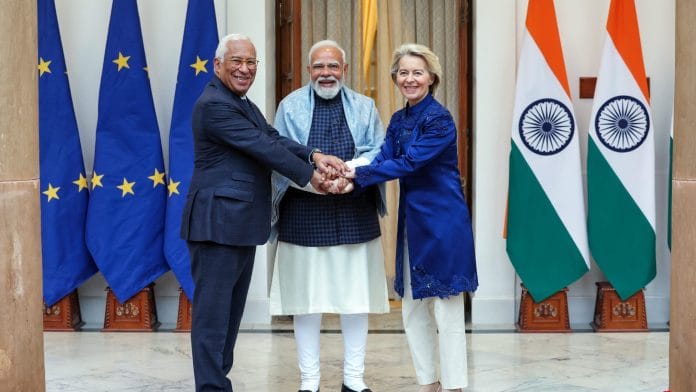
The agreement covers trade between India and the EU’s 27 member states, and leaders described it as a deal with very large impact potential due to the size of both markets. Officials indicated it could take several months before the pact becomes effective because the text must undergo legal scrubbing and then clear ratification processes.
What the agreement changes on tariffs
Under the announced framework, India is expected to reduce or eliminate tariffs for 96.6% of EU exports by trade value, while the EU will phase tariff reductions that ultimately cover close to 99% of India’s exports by trade value. The objective is to expand bilateral trade and bring down the cost of duties on a wide range of goods.
One of the most watched areas is automobiles and premium beverages. Reports said India’s high tariff on EU-made cars is set to decline sharply over time, while quotas and phased reductions were also referenced for wines and spirits. Machinery, chemicals and pharmaceuticals were among other categories expected to see significant duty reductions or eliminations over agreed timelines.
Sectors expected to gain in India and Europe
- India: textiles and apparel, engineering goods, leather, footwear, handicrafts and marine products are among the sectors cited as beneficiaries.
- EU: automobiles, chemicals, pharmaceuticals, and premium beverages are among the sectors expected to gain from improved access and lower duties.
Beyond tariffs, the announcement also pointed to broader cooperation areas, including supply chain integration, manufacturing linkages and a parallel push on strategic coordination. Some updates also referenced support aimed at clean energy and emissions reduction as part of the wider India-EU partnership agenda.
Next steps: legal text, ratification and timing
Although negotiations are concluded, the deal still needs legal finalisation and approvals. The process typically includes legal scrubbing of the text, political clearance in India, and ratification steps in the EU system, including the European Parliament and member states. Until those steps are completed, the agreement is not fully enforceable.
If the ratification timeline holds, both sides expect the pact to be implemented in phases, with tariff cuts and market-opening measures rolling out over multiple years rather than overnight.